Episode Transcript
[00:00:00] Foreign.
[00:00:07] It's Rick. Welcome back to the Nomad Pastor Podcast.
[00:00:10] If you caught the last episode we walked through First Peter Chapter one. If you didn't, I recommend you go back and listen to that before you listen to this one, because this week we're going to walk through First Peter Chapter two. Now, in chapter one, the big idea was it was really about identity. You're chosen, you have a living hope, and your inheritance is locked down before anything else got decided.
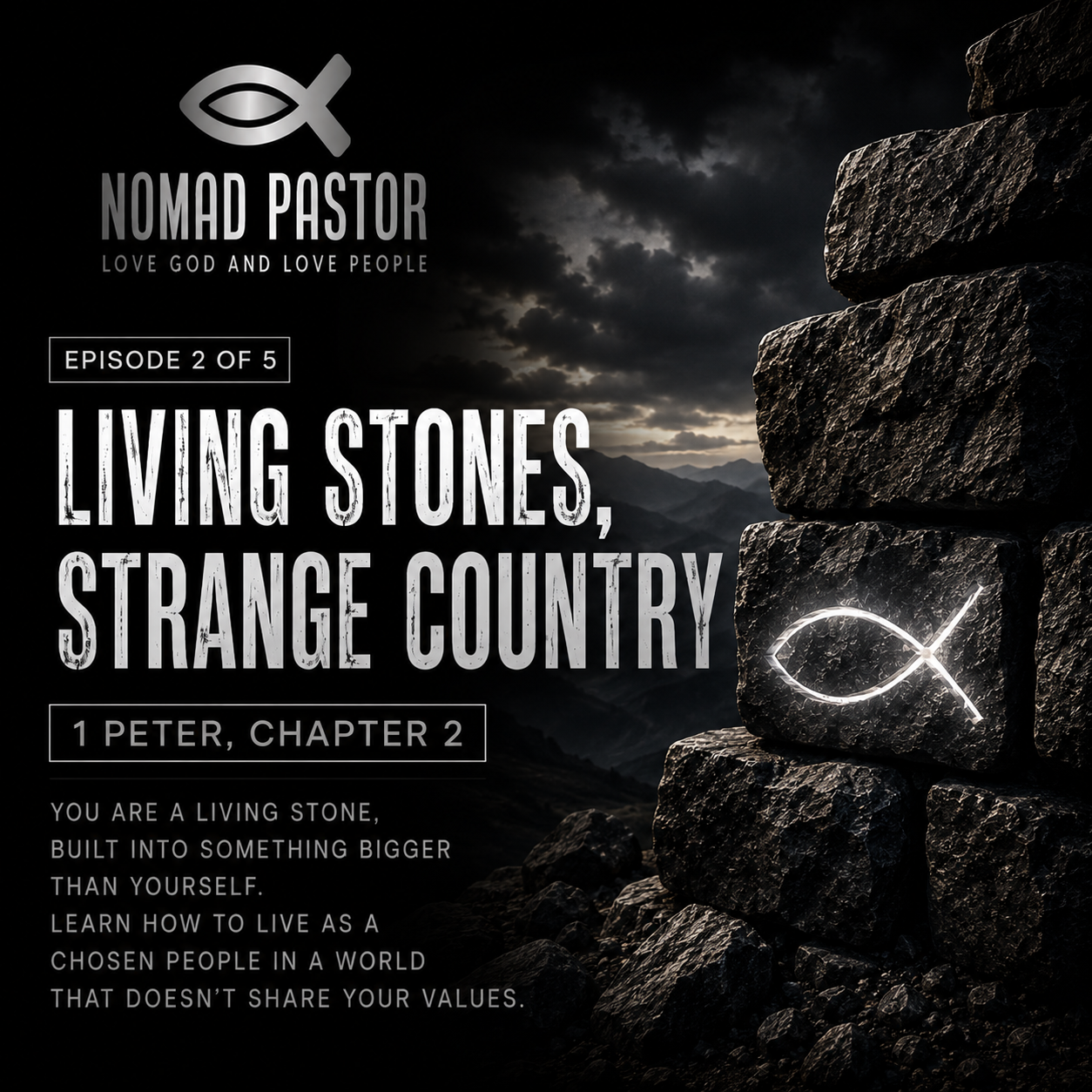
[00:00:34] And so this week or this episode in chapter two, Peter takes that identity and he starts building with it. And I mean building with it literally. He uses the picture of a building, stones being fitted together.
[00:00:49] And then later in the chapter, he's going to talk about how to live as outsiders in a culture that doesn't operate by our values. And I think this is.
[00:00:59] It's super important today in society because our culture, generally, we are outsiders to the culture.
[00:01:09] And so if you've ever felt like the odd one out, whether you're at work or with your family or with the people you used to hang out with, like your old crew or whatever you want to call them, this chapter has got something for you.
[00:01:24] And so as we jump in one, Peter, chapter two starts with a list.
[00:01:31] Putting aside all malice and all deceit and hypocrisy and envy and all slander, like newborn babies long for the pure milk of the Word so that by it you may grow in respect to salvation.
[00:01:47] So I want to notice, I want everybody to notice the order here. He doesn't say, trying harder to be good and eventually you'll want God's word. He. He says, put off this list of stuff first, right? Putting aside all malice, deceit, hypocrisy, envy, slander, and then long for the Word, like a newborn baby longs for milk.
[00:02:11] So when you think about that, right, you know, think about the newborn.
[00:02:15] A baby doesn't have to be talked into wanting milk.
[00:02:19] Nobody's convincing them that it's a good idea.
[00:02:22] The hunger is built in, right? They know they need it. They want it.
[00:02:27] So Peter is saying that's what our appetite for God's word should look like.
[00:02:33] Like a newborn baby longs for milk without any convincing.
[00:02:41] Not a chore, not something you force on yourself.
[00:02:47] It's not something you do because you should, but something you actually crave because it's feeding something real inside of us.
[00:03:01] Look, for a lot of us, this list that Peter gives, malice, deceit, hypocrisy, envy, slandered.
[00:03:10] That's not just sin in some abstract Sense, that's survival mode. And if you've lived in the. In our culture today, in an environment where you have to watch your back constantly, you learned those things because they kept you alive.
[00:03:31] We learned to be deceptive because honesty gets us hurt.
[00:03:37] We've learned envy because everybody around us had something we didn't.
[00:03:43] And resentment was easier than hope.
[00:03:48] We learned to talk about people before they could talk about us.
[00:03:53] That's how our culture has been.
[00:03:57] Peter's not condemning us for learning to survive.
[00:04:00] He's saying, that's not who we are anymore.
[00:04:05] That's not going to feed us anymore.
[00:04:09] Stop doing it and put it down.
[00:04:12] There's something better to feed on now.
[00:04:18] And as we move through verses 4 and 5, this is where that building picture starts, right? And it says, coming to him as to a living stone which has been rejected by men, but is choice and precious in the sight of God. You also, as living stones, are being built up as a spiritual house for a holy priesthood to offer up spiritual sacrifices acceptable to God through Jesus Christ.
[00:04:48] Jesus is called a living stone, rejected by men, but precious to God.
[00:04:59] You see, the world looked at Jesus and said, not worth it. Throw him out, put him on a cross.
[00:05:08] God looked at that same person and said, this is the foundation of everything.
[00:05:17] How many people listening have been rejected, told you're not worth it, told you're a lost cause.
[00:05:30] Maybe you were told that by an employer, a family member, whatever system, maybe even by yourself in your own head.
[00:05:43] I've said it to myself countless times, I'm not worth it.
[00:05:53] You don't fit.
[00:05:55] You're not useful.
[00:05:59] But Peter's telling us that the one we're building our life on went through the exact same thing.
[00:06:08] And God's response was the opposite of man's response.
[00:06:13] What men rejected, God made the cornerstone.
[00:06:18] And then you also, as living stones are being built.
[00:06:24] He says, you, not just Jesus, you're part of this structure now.
[00:06:31] We are not spectators. We are not somebody standing outside looking at a building, wondering if there is room.
[00:06:41] We are one of the stones it's being built out of.
[00:06:48] You know, when we think about stones, I think there's something we often miss.
[00:06:54] You see, a stone doesn't get to pick where it goes in the wall.
[00:07:00] The builder places it there.
[00:07:04] So you might feel like you're sitting somewhere right now. That doesn't make any sense to you.
[00:07:09] And you're wondering, why am I here?
[00:07:12] What's the point of this?
[00:07:15] But remember, the builder places stones where they're needed for that structure to hold my placement. And your placement is not random.
[00:07:29] Even when it feels random to you, it's not.
[00:07:36] Verse 6 through 8 talks about the same stones being a cornerstone for some, those who believe, and a stone of stumbling for others, those who reject.
[00:07:50] Same stone, different outcomes.
[00:07:53] It all depends on what we do with it.
[00:07:56] That's worth thinking about and remembering.
[00:07:59] You see, Jesus isn't neutral. And I know that in today's culture and society, a lot of people say, well, Jesus just loves everyone.
[00:08:07] It doesn't matter what you think, what you do, or how you do it.
[00:08:11] Jesus isn't neutral.
[00:08:14] He's either the foundation of our lives.
[00:08:22] Or he's something you trip over.
[00:08:27] There's no version where he's just neutral in the middle or irrelevant.
[00:08:35] And then there's verse nine. And I really want you to listen to this because I think this might be my opinion. One of the most important verses in the whole chapter, but it says, but you are a chosen race, a royal priesthood, a holy nation, a people for God's own possession, so that you may proclaim the excellencies of him who has called you out of the darkness into his marvelous light.
[00:09:08] Man.
[00:09:10] Chosen, royal, holy, God's own possession.
[00:09:19] If you say those words slowly to yourself when you feel like none of those things describe you.
[00:09:31] Chosen, royal, holy, God's own possession.
[00:09:37] I mean, royal, that's the word for kings and their families.
[00:09:43] Not for people like me.
[00:09:48] Not for people whose families have written them off. I'm not saying mine have. I'm just saying royal is kings and families.
[00:09:59] But that's exactly who Peter is writing to here. Scattered exiles, people with nothing, and he calls them royal.
[00:10:10] This isn't Peter just being nice.
[00:10:15] This is Peter telling them the truth about their new identity in Christ.
[00:10:23] A truth that has nothing to do with bank accounts or their record or their housing situation or their relationship status or their job status or what anybody thinks of them.
[00:10:38] Called out of darkness into his marvelous light. Not called to clean yourself up first and then maybe get invited into the light.
[00:10:47] It says, called out of the darkness while you were still in it, into the light.
[00:10:56] The calling is what gets you out. You don't get yourself out and then get called.
[00:11:04] Verse 10.
[00:11:06] For you once were not a people, but now you are the people of God. You had not received mercy, but now you have received mercy. Once you were nothing. Now you were something.
[00:11:19] That's the whole gospel in one verse if you want me to be honest with you, period. Mic drop.
[00:11:27] For you were once.
[00:11:29] For you once were not a people, but now you are the people of God.
[00:11:38] You were nothing, and now you're something.
[00:11:45] Then we go to verse seven.
[00:11:47] You know, Peter in verse seven shifts how we live in the light for all of this, right?
[00:11:55] And he says, beloved, I urge you as aliens and strangers to abstain from fleshly lusts which wage war against the soul.
[00:12:07] There's those words again, right? Aliens, strangers. Same words as chapter one.
[00:12:13] You're not home yet. You're passing through.
[00:12:16] And because you're passing through, there are things that might look attractive in this place, but they are not worth dragging along with you because they're at war. Those things that look attractive with the very soul of God, That's a lot.
[00:12:40] Because in our society today, in our culture today, there's a lot of things that look attractive, but they're not worth dragging along.
[00:12:55] They are at war with our soul.
[00:12:57] Our soul that God just called royal and holy.
[00:13:06] Verse 12.
[00:13:08] Keep your behavior excellent among the Gentiles, so when they slander you, they may see your good deeds and glorify God.
[00:13:19] Peter knows people are going to talk.
[00:13:23] People are going to judge you based on your past, based on where you've been, based on assumptions, based on what they see, based on what they feel, based on nothing.
[00:13:35] They're still going to judge you.
[00:13:38] And the answer that Peter gives isn't go argue with them or go prove them wrong.
[00:13:44] It's let your life do the talking.
[00:13:48] Let what they see now contradict what they've assumed before.
[00:13:55] And this verse, this.
[00:14:00] Live it out and let them see and don't argue. It's really hard for me.
[00:14:04] It's really hard for me because I want to defend myself.
[00:14:08] I want to show you, but that doesn't help anything.
[00:14:15] So all I can do is live a life that contradicts what they believe, and maybe someday they'll see it.
[00:14:30] Then we go verses 13 through 17. And they get into this submission to authorities, right? Governments, employers, that kind of thing.
[00:14:41] And Peter's writing to people under government, under a government that was actively hostile to Christians, sounds like today.
[00:14:52] And he still says, honor the authorities, do what's right, live as free people, but don't use your freedom as an excuse to do evil.
[00:15:04] That's a hard one, right?
[00:15:10] Peter's not saying that the system is always right.
[00:15:17] He is saying, don't give them a legitimate reason to come after us.
[00:15:21] Live in such a way that if trouble comes, it's not because we gave them ammunition.
[00:15:33] That submission to authority, that's a hard one.
[00:15:41] People want to do what people want to do.
[00:15:44] And they don't care who's going to tell them yes or no.
[00:15:49] But when a culture is hostile to people, you still have to honor them. You still have to honor authorities and do what's right.
[00:16:01] And after verse 17, the chapter shifts into something really important.
[00:16:06] And it, you know, after 17, Peter starts to talk to servants, to people in hard situation, under what I could imagine is harsh masters. And he says something that I think speaks directly to people dealing with an unfair situation, whether it's an unfair boss or an unfair spouse, or an unfair parent or parole officer or whatever it may be, it's an unfair situation that you just can't walk away from.
[00:16:41] And he says it's commendable if because of conscience towards God, a person bears up under sorrow when suffering unjustly. Not because suffering is good, but because enduring it with your eyes on God, instead of becoming bitter or becoming someone you're not.
[00:17:02] That's how Christ is honored.
[00:17:06] He says it's commendable.
[00:17:12] I don't know how to deal with that, being honest when people are suffering, especially suffering unjustly.
[00:17:25] But Peter is telling us, right, don't become bitter.
[00:17:30] Don't become someone you're not.
[00:17:32] And when you don't become bitter, and when you don't become someone you're not, that's when Christ is honored.
[00:17:42] And then Peter points to Jesus as an example in verses 21 to 24, he's pointing to Christ. He's saying, christ suffered for us, leaving example for us to follow. In his steps, he committed no sin, no deceit was found in his mouth.
[00:18:03] When he was reviled, he didn't revile back. When he suffered, he didn't threaten.
[00:18:08] He entrusted himself to the One who judges righteously.
[00:18:13] He bore our sins in his body on the cross.
[00:18:18] That's the model.
[00:18:20] Not never get hurt, not never get treated unfairly, because you will.
[00:18:27] And so did Jesus Christ.
[00:18:31] You see, the model is when it happens, you don't have to become the thing that hurts you.
[00:18:40] You can entrust yourself to God the same way Jesus did, and you can keep walking.
[00:18:48] And then the chapter closes in verse 25.
[00:18:53] For you were continually straying like sheep, but now you have returned to the shepherd and guardian of your souls.
[00:19:03] Straying like sheep, lost, wandering off.
[00:19:10] That's where we were. But now we're returned under a shepherd who guards us.
[00:19:16] That's where we are.
[00:19:22] So here's what I want you to take. In the next couple weeks, you're a living stone, placed exactly where the builder needs you right now.
[00:19:35] And even if you're sitting where it doesn't make sense, it's okay.
[00:19:40] You're part of a chosen race, a royal priesthood, a holy nation, not because of your record, but because of his calling.
[00:19:53] And whatever unfair situation you're in right now, you don't have to become bitter to survive it.
[00:20:05] You can do the same thing Jesus did and trust the one who judges righteously.
[00:20:16] So last week, at the end of. Not last week, but the last episode, at the end of the episode, I talked about a challenge for a week, and I'm going to start doing this more.
[00:20:27] So your challenge this week, find one place where you've been treated unfairly.
[00:20:36] And instead of rehearsing it over and over again in your head, I want you to practice handing it to God out loud. Just say it.
[00:20:47] God, I'm handing this to you, and I'm not carrying it as my identity anymore.
[00:20:53] And every time that thought comes back to your mind, I want you to do the same thing.
[00:21:02] Just say it, God, I'm handing this to you. I'm not carrying this as my identity anymore.
[00:21:13] Over and over.
[00:21:16] I think you'll be surprised at how impactful that can be.
[00:21:23] Next episode, we're going to go through chapter three.
[00:21:25] Peter's going to get into relationships, especially marriage and what it looks like to live with people who are hard to live with.
[00:21:34] And if you've got relationships in your life that feel impossible, you're going to want to hear it.
[00:21:40] I want to thank you for listening again. This is Rick with the Nomad Pastor podcast.
[00:21:45] Hey, like, save, share, subscribe, do whatever you got to do.
[00:21:51] I just want to remind you to love God and love people.